


Most furniture regrets start with the core, not the finish. A long wardrobe shutter that sags in the middle after a year, a full-height door that feels too heavy and drags on its hinges, a bookshelf that bows under a row of books: these are core problems, not laminate problems. Block board and plywood are the two cores behind almost every piece of Indian furniture, and they are built very differently. This guide compares block board vs plywood honestly, based on where each one performs, so you can pick the right core for the job instead of guessing at the shop counter.
Quick Answer: Block Board or Plywood?
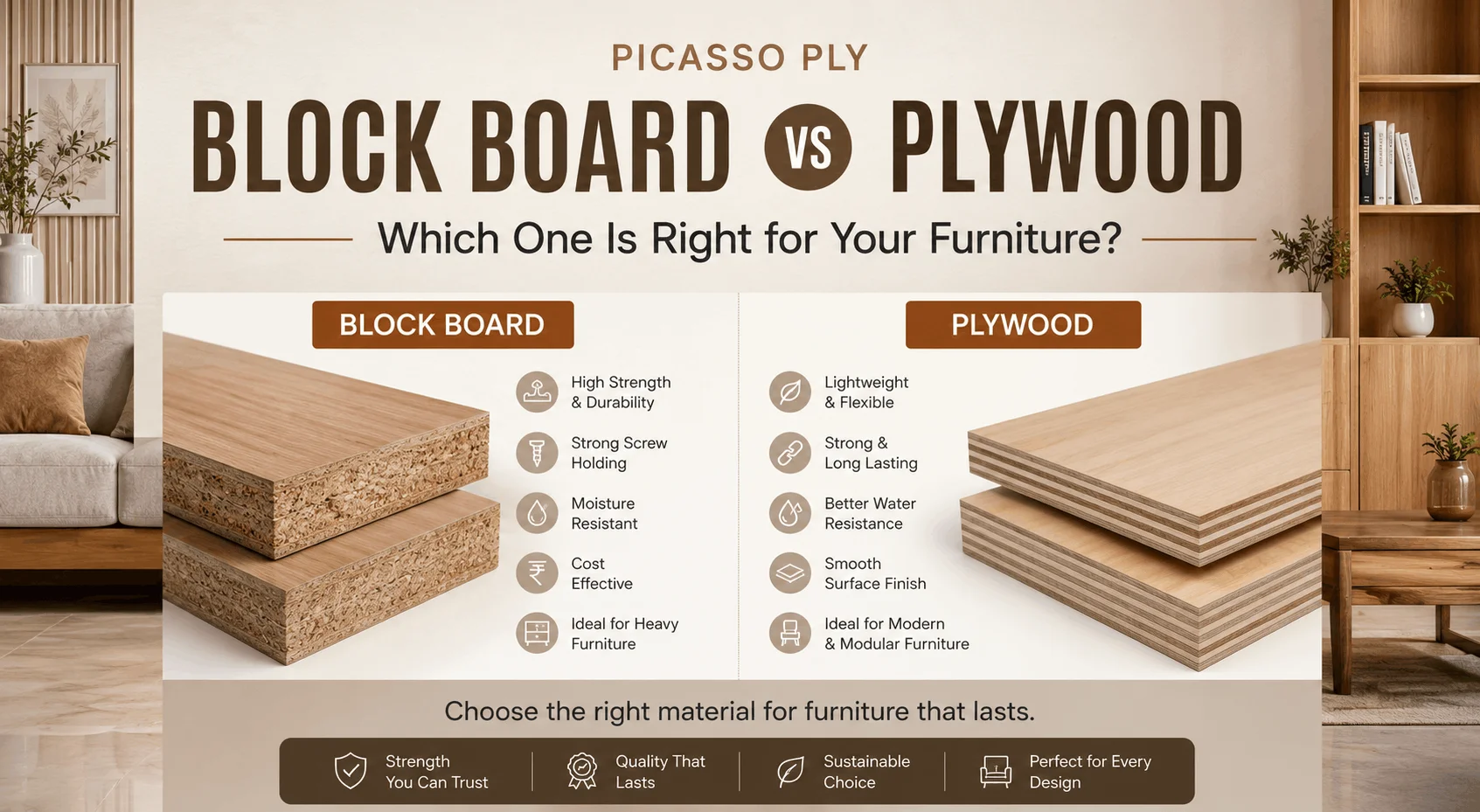
If you want the short version, plywood is stronger, holds screws better, and handles moisture better, so it suits kitchen units, load-bearing furniture, and shorter shutters. Block board is lighter and resists sagging over long spans, so it suits long shutters, full-height wardrobes, doors, and long tabletops. Neither wins everywhere, and the right pick depends on the piece. Here is the full breakdown.
What Is Block Board?
Block board is made from a core of softwood battens, usually pine, glued edge to edge and then sandwiched between veneer layers on both faces. That solid-wood-strip core is the reason block board is lighter than plywood and resists bending over long lengths, which is why it is a favourite for long shutters and doors. The honest trade-off is that the battened core and fewer plies mean weaker screw grip at the edges and lower moisture tolerance than good plywood, so block board is a poor choice anywhere near constant water.
What Is Plywood?
Plywood is made by stacking thin wood veneers and bonding them under heat and pressure, with each layer turned at right angles to the one below. That cross-layered grain gives plywood all-round strength and strong screw-holding, and it is why plywood resists cracking. It comes in grades suited to different moisture levels, from MR for dry indoor use to BWP marine grade for wet zones. The plywood grades guide explains those in detail, and the complete plywood guide covers types and thickness.
Block Board vs Plywood: Head-to-Head Comparison
This is the heart of the block board vs plywood question. The table below shows where each material leads so you can weigh the trade-offs against your own piece of furniture.
| Factor | Block Board | Plywood |
|---|---|---|
| Strength / load-bearing | Good along the length, weaker across width | Stronger in all directions |
| Screw-holding | Weaker at edges, core has gaps | Excellent, grips firmly |
| Sagging over long spans | Resists sagging, stays straight | Can sag over very long unsupported spans |
| Weight | Lighter, easier on hinges | Heavier |
| Moisture resistance | Low, not for wet areas | Good in BWR or BWP grades |
| Surface for lamination | Smooth and flat | Smooth, very stable |
| Workability | Easy to cut, light to handle | Strong but heavier to work |
| Cost for large flat pieces | Often cheaper | Usually higher |
| Best use | Long shutters, doors, tabletops | Kitchens, load points, small units |
Read together, the pattern is clear. Plywood wins on strength, screw-holding, and moisture, which matters for kitchens, wet zones, and anything carrying repeated stress. Block board wins on weight and on staying straight over long spans, which matters for tall shutters, doors, and long tabletops. The smartest projects use both, matching each core to the demand of the piece.
Which Is Better for Each Use? (Verdict by Furniture Type)
Here is the practical verdict for the pieces people ask about most, along with common block board uses:
- Long wardrobe shutters and full-height doors: block board. Its light weight and resistance to sagging keep a tall shutter straight and easy on the hinges. In the block board vs plywood for wardrobe question, block board usually wins for the shutters themselves.
- Kitchen cabinets and wet areas: plywood, in a BWR or BWP grade. The block board vs plywood for kitchen decision favours plywood every time, because block board does not handle the moisture and steam of a kitchen well.
- Long shelving and tabletops: block board for the long unsupported spans, since it bows far less than plywood over length.
- Drawers, small cabinets, and intricate work: plywood. Its stronger edge and screw grip suit small joints and repeated fixing better.
- Door shutters and flush door cores: block board for door shutters is a common, sensible choice, and it also works as a core inside flush doors because it keeps a large door light and flat.
- Heavy storage and load-bearing units: plywood, for its all-round strength and reliable screw-holding.
Cost Comparison: Block Board vs Plywood
On block board price vs plywood, block board often works out cheaper for large flat pieces, partly because of its lighter build and simpler core. That is one reason it is popular for big wardrobes and long tabletops where using plywood would add weight and cost. But price per sheet is not the full story. In damp or high-use areas, plywood in the right grade lasts longer and needs less repair, so it can be better value over time even at a higher upfront price. Both vary by grade, brand, thickness, and city, so treat any figure as a starting point and compare total cost for the specific use rather than the sticker price alone.
When Plywood Is the Safer Choice
Block board has clear strengths, but plywood is the safer pick in a few situations, and it is worth being straight about that. Anything in or near water, such as kitchen and bathroom units, should be plywood in a boiling-water-proof grade rather than block board. Anything that needs strong, repeated screw fixing, such as hinges on a heavy door or wall-mounted load-bearing units, also does better in plywood. For those jobs, a good BWP option like calibrated plywood gives strength and moisture resistance that block board cannot match. If the piece is heavy, wet, or high-stress, plywood is the reliable answer.
How to Choose Between Block Board and Plywood
Run your piece through this short checklist before deciding:
- Span length: long shutters, doors, and tabletops point to block board, since it resists sagging.
- Weight sensitivity: if the piece hangs on hinges or needs to stay light, block board helps.
- Moisture exposure: any contact with water points to plywood in a BWR or BWP grade.
- Load and screw stress: heavy loads and repeated fixing point to plywood.
- Finish: both take laminate and veneer well, so the choice is about structure, not surface.
The mix most carpenters actually use is block board for long shutters, doors, and tabletops, with plywood for kitchens, load points, and small units. This is also how a manufacturer that makes both, such as Piccaso Ply, tends to advise customers, because the honest recommendation is rarely one material for the whole house. It is the right core in the right place.
Frequently Asked Questions
Is block board stronger than plywood?
Not overall. Plywood is stronger in all directions and holds screws better, which is why is block board strong is a fair question with a nuanced answer. Block board is strong along its length and resists sagging over long spans, but it is weaker across its width and at the edges, so plywood is the tougher core in most uses.
Is block board good for wardrobes?
Yes, especially for long wardrobe shutters and full-height units. Block board is light and resists sagging, so tall shutters stay straight and easy on the hinges. Many carpenters use block board for the shutters and doors and switch to plywood for load-bearing shelves and any section near moisture.
Can block board be used in the kitchen?
It is not the best choice. Block board has low moisture resistance, so kitchen steam, spills, and humidity can damage it over time. For kitchen cabinets, plywood in a BWR or BWP marine grade is the safer core because it handles water far better and holds screws reliably in wet conditions.
Does block board sag less than plywood?
Yes, over long spans. The solid softwood core of block board resists bending along its length, so long shutters, doors, and tabletops stay straighter than they would in plywood. This is the main reason block board is chosen for tall wardrobes and long unsupported shelving.
Is block board cheaper than plywood?
Often, for large flat pieces. Block board price vs plywood usually favours block board on big shutters and tabletops because of its lighter, simpler core. Plywood can still be better value in wet or high-use areas, since it lasts longer there, so compare total cost for the specific use rather than the sheet price.
Which is better for a main door, block board or plywood?
Block board is the common choice for door shutters, because it keeps a large door light and flat and resists sagging. Plywood is used where a door faces moisture or needs extra strength around locks and hinges. Many doors combine a block board core with a sturdy frame for the best result.
The block board vs plywood decision is not about which is better in the abstract. It is about matching the core to the piece. Use block board where you need a light, straight panel over a long span, such as tall shutters, doors, and tabletops, and use plywood where you need strength, screw-holding, and moisture resistance, such as kitchens and load-bearing units. Price the whole finished job, not the bare sheet, and combine the two where it makes sense. Suppliers that manufacture both, including Piccaso Ply, can match the right core to each part of your furniture rather than forcing one material to do every job.