


Ask any site engineer about formwork gone wrong and you will hear the same story: sheets that swell, bow, or delaminate after two or three pours, leaving a rough concrete finish and a material budget that has already run over. Shuttering plywood is built to avoid exactly that. It is the plywood that holds wet concrete in place while it sets, and the right sheet earns its cost back across repeated casts. This guide is written for contractors, builders, and site engineers who buy on performance and cost-per-use, covering what shuttering plywood does, how many times it lasts, and how to pick the right sheet.
What Is Shuttering Plywood?
Shuttering plywood is a strong, water-resistant plywood made specifically for concrete formwork, which on site is called shuttering. It is engineered to take the pressure and moisture of wet concrete, hold its shape while the concrete sets, and then be stripped off and reused for the next cast. The honest point most buyers miss is that not every sheet labelled waterproof is true shuttering grade. Real shuttering ply uses a boiling-water-proof bond and a tougher core, which is what lets it survive repeated pours rather than falling apart after a few uses.
What Is Shuttering Plywood Used For? (Main Uses)
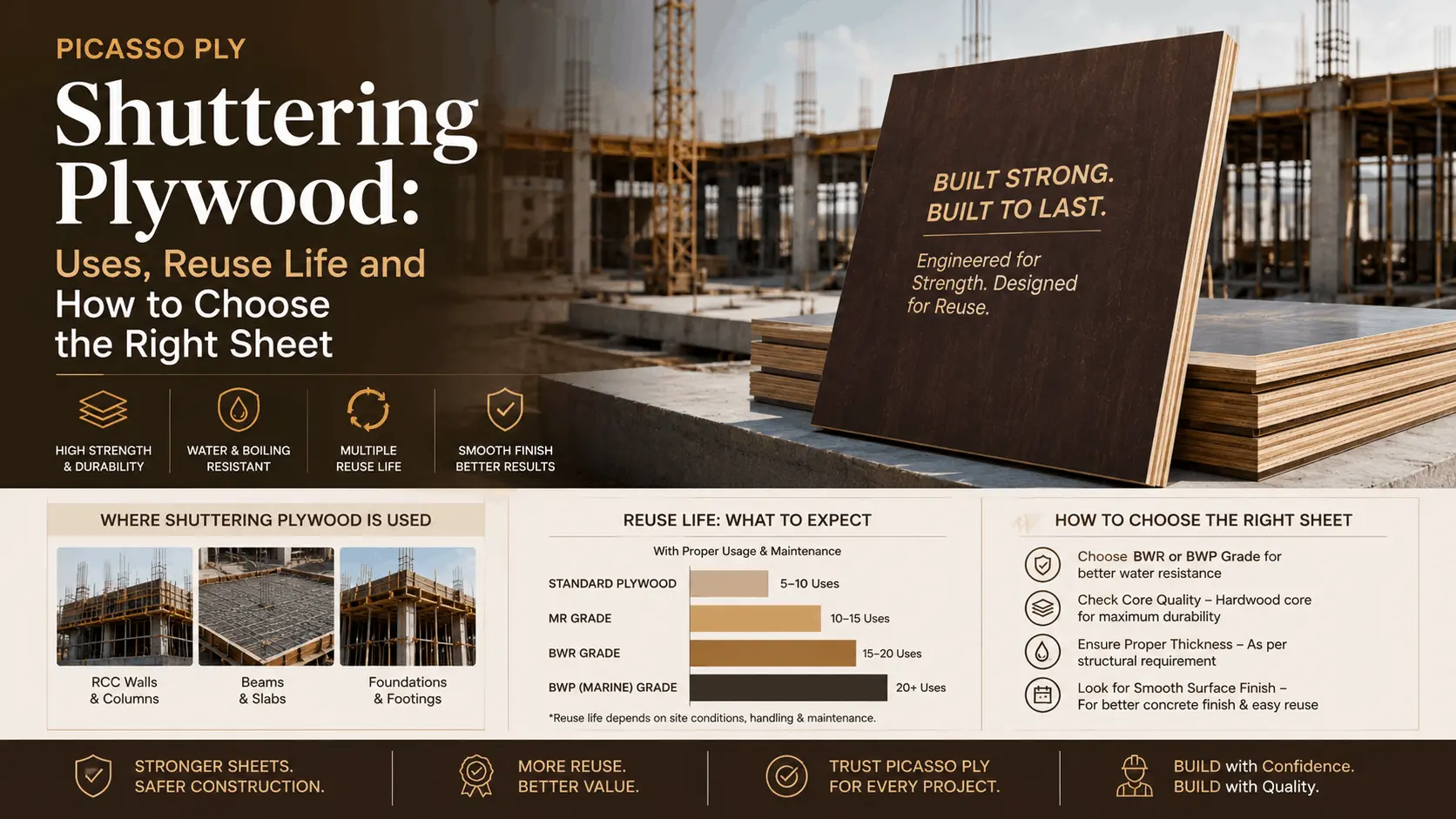
The main shuttering plywood uses on a construction site are:
- Column and beam formwork: holding the shape of vertical columns and horizontal beams while concrete sets.
- Slab and roof casting: forming the flat base for floor and roof slabs.
- Wall and foundation shuttering: containing concrete for retaining walls, basements, and foundations.
- Staircases: shaping the steps and landings of cast staircases.
- Repeat structural work: any element cast many times across a project, where reuse life matters most.
Film-Faced vs Plain Shuttering Plywood
The film faced plywood vs shuttering plywood question comes up often, and the simple answer is that film-faced ply is a premium type of shuttering plywood, not a separate product. Plain shuttering ply has a sanded wood face, while film-faced ply carries a phenolic film coating that seals the surface. The table below shows how they compare.
| Factor | Plain Shuttering Plywood | Film-Faced Plywood |
|---|---|---|
| Surface finish on concrete | Fair, some texture | Smooth, near-plaster finish |
| Reuse life | Fewer pours | More pours per sheet |
| Water and bond resistance | Good | Higher, sealed film face |
| Cost per sheet | Lower upfront | Higher upfront |
| Cost per use | Higher over many casts | Often lower over many casts |
| Best for | Smaller or one-off jobs | Large, repeat, finish-critical work |
The takeaway is that film-faced ply costs more per sheet but can work out cheaper per use on big projects, because it survives more pours and gives a smoother concrete face that needs less finishing. Plain shuttering ply makes sense on smaller jobs where the reuse count is low.
How Many Times Can Shuttering Plywood Be Reused?
How many times can shuttering plywood be reused is the question that decides real project cost, and the honest answer is that it depends on the sheet and how it is handled. As a broad guide, plain shuttering plywood commonly gives several to around ten uses, while good film-faced plywood can give many more, sometimes several times that, when looked after well. What moves the number is the grade and bond quality, the release agent used, how carefully the ply is stripped, and how it is stored between pours. The right way to compare sheets is not the price per sheet but the cost per use across the whole project.
Shuttering Plywood Thickness and Sizes
Shuttering plywood thickness is usually 12mm and above, with a common site standard around 12mm for general work and thicker sheets used where loads are heavier. The standard sheet size is typically 8 feet by 4 feet, matching most formwork layouts. As a rough guide, thicker ply suits slabs and heavy load areas, while standard thickness handles most wall and column work. Always match the thickness to the span and load rather than defaulting to the thinnest option, since a sheet that flexes under load ruins the finish and cuts its own reuse life.
What Affects Shuttering Plywood Price?
Shuttering plywood price moves on a few clear factors: whether the sheet is film-faced or plain, the grade and bond quality, the thickness, the core wood used, and the brand. A cheaper sheet that survives only three pours can cost more in the end than a pricier sheet that lasts many, which is why cost-per-use matters more than the sticker price. Rates vary by grade, brand, and city, so treat any single figure as a starting point and compare on how many casts each sheet will realistically deliver.
How to Choose the Right Shuttering Plywood
Run your project through this short checklist before ordering:
- Expected reuses: more casts justify film-faced ply for a lower cost per use.
- Concrete finish needed: finish-critical work points to a smooth film face.
- Thickness for the load: heavier loads and longer spans need thicker sheets.
- Water resistance and bond: insist on a genuine boiling-water-proof bond.
- Verified grade: ask for the grade and IS marking rather than trusting a waterproof label. The plywood grades guide explains what those markings mean.
How to Get More Reuses From Your Shuttering Ply (Site Tips)
A good sheet still needs good handling to reach its full reuse life. A few practical habits make a real difference:
- Apply a proper shuttering release agent before every pour so the ply strips clean.
- Clean concrete residue off the face between casts rather than letting it build up.
- Strip carefully, avoiding crowbars against the face that dent and crack the surface.
- Store sheets flat, dry, and off the ground, not leaning in the sun or rain.
- Seal cut edges, since exposed edges soak up water and delaminate first.
Handled this way, even mid-range shuttering ply delivers noticeably more casts, which is where the real savings on a project come from. Piccaso Ply supplies shuttering plywood built for this kind of repeat use, so the sheets hold up across pours rather than after just a few.
Frequently Asked Questions
What is shuttering plywood used for?
Shuttering plywood is used for concrete formwork on construction sites. It holds wet concrete in shape while it sets, then is stripped and reused. Common shuttering plywood uses include columns, beams, slabs, walls, foundations, and staircases, especially on structural work that is cast many times across a project.
How many times can shuttering plywood be reused?
It depends on the sheet and handling. Plain shuttering plywood commonly gives several to around ten uses, while good film-faced plywood can give many more when looked after. Grade, release agent, careful stripping, and dry storage all affect the count, so compare sheets on cost per use rather than price alone.
What is the difference between film-faced and shuttering plywood?
Film-faced plywood is a premium type of shuttering plywood, not a separate product. It carries a phenolic film coating that seals the surface, giving a smoother concrete finish and more reuses than plain shuttering ply. Plain shuttering plywood has a sanded wood face and suits smaller or one-off jobs.
What thickness of shuttering plywood is best for slabs?
Slabs and heavy-load areas generally need thicker shuttering plywood, since thin sheets flex under the weight of wet concrete and spoil the finish. A common site standard is around 12mm for general work, with thicker sheets used for slabs and long spans. Match the thickness to the load rather than defaulting to the thinnest.
Is shuttering plywood waterproof?
Genuine shuttering plywood uses a boiling-water-proof bond, so it handles the moisture of wet concrete and repeated pours. Not every sheet labelled waterproof is true shuttering grade, though, so ask for the grade and IS marking. A proper bond is what lets the ply survive many casts instead of delaminating early.
What is the standard size of a shuttering plywood sheet?
The standard shuttering plywood sheet size is typically 8 feet by 4 feet, which matches most formwork layouts. Thickness usually starts at 12mm and goes up for heavier loads. Standard sizing keeps cutting waste low and makes it easier to plan formwork around whole sheets on site.
Shuttering plywood is a cost-per-use decision, not a sticker-price one. The right sheet holds its shape across pours, gives the concrete finish your job needs, and pays back its cost over many casts, while a cheap sheet that fails after three pours quietly costs more. Match the type and thickness to the work, insist on a genuine boiling-water-proof bond, and handle the sheets well on site. Buying from a manufacturer that states its grade clearly, such as Piccaso Ply, means you know what you are getting before the first pour.