


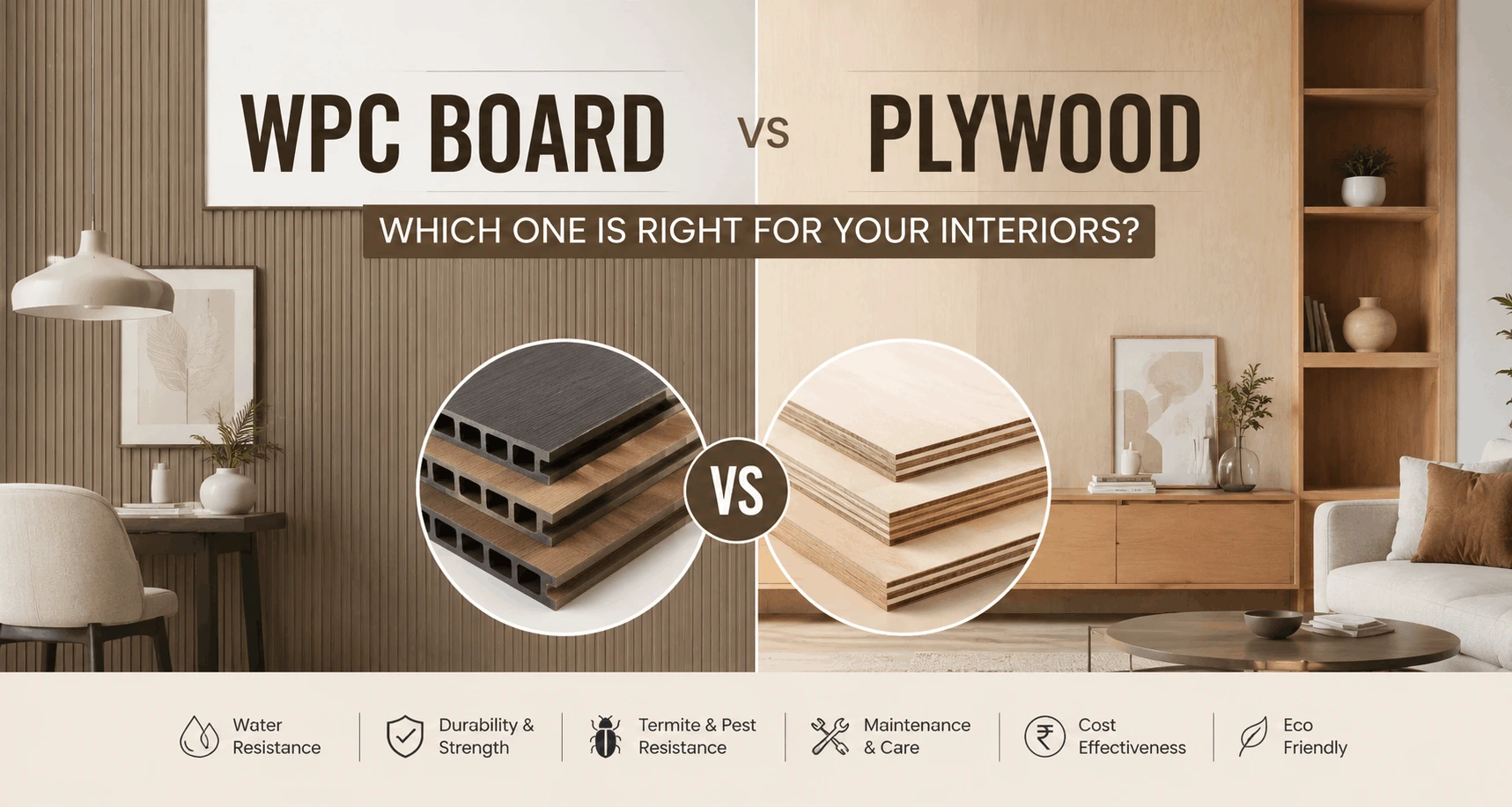
Anyone who has lived through an Indian monsoon knows the sinking feeling of opening a kitchen cabinet and finding the base swollen and soft, or spotting a bathroom vanity that has puffed up and started to peel at the edges. In humid conditions, untreated or basic MR-grade plywood often fails after repeated water exposure and wipe-downs, while WPC tends to hold its shape in wet zones. That single difference is what sends most people searching for an answer. This guide compares WPC board vs plywood honestly, based on where each one actually performs, so you can pick the right material for your project rather than the one with the loudest sales pitch.
Quick Answer: WPC or Plywood?
If you want the short version, plywood is the better choice for load-bearing furniture and dry interiors because it is stronger and holds screws far better. WPC board is the better choice for moisture-heavy areas such as kitchens, bathrooms, and outdoor furniture because it resists water and termites by nature. Neither is universally better, and the right pick depends on the room. Read on for the full breakdown.
What Is Plywood?
Plywood is an engineered wood made by stacking thin wood veneers and bonding them together under heat and pressure, with each layer turned at right angles to the one below. That cross-layered grain is where its strength comes from, and it is why plywood resists cracking and holds screws so well. It comes in grades suited to different jobs: MR (moisture-resistant) for dry indoor furniture, BWR (boiling water-resistant) for areas that see occasional damp, and BWP or marine grade for the most demanding wet conditions. If you want the full picture on grades and thickness, the complete plywood guide covers it, and the product pages for calibrated plywood and shuttering plywood show where each type fits.
What Is a WPC Board?
WPC stands for wood plastic composite. It is made by mixing wood fibre or wood flour with a thermoplastic such as PVC or polyethylene, then forming it into solid boards. Because plastic runs all the way through the material, a WPC board does not absorb water the way wood does, which makes it water-resistant and termite-proof without extra treatment. The trade-off is real and worth stating plainly: WPC is lighter and does not grip screws as firmly as plywood, and it generally costs more upfront. So it wins on moisture but gives up some structural strength in return.
WPC vs Plywood: Head-to-Head Comparison
This is the heart of the WPC board vs plywood question. The table below lays out where each material leads, so you can weigh the trade-offs against your own project.
| Factor | Plywood | WPC Board |
|---|---|---|
| Strength / load-bearing | Stronger, better for heavy furniture | Adequate, not for high loads |
| Screw-holding | Excellent, grips firmly | Weaker, screws can loosen over time |
| Water resistance | Good only in BWR or marine grades | Water-resistant by nature |
| Termite resistance | Needs treatment | Termite-proof by composition |
| Weight | Heavier | Lighter, easier to handle |
| Cost per sq ft | Generally lower upfront | Generally higher upfront |
| Maintenance | Needs sealing and care in damp areas | Low, wipe clean |
| Finish options | Needs lamination or veneer | Paintable and laminatable |
| Lifespan | Long if kept dry and sealed | Long, especially in wet zones |
Read together, the pattern is clear. Plywood wins on structure, strength, and screw-holding, which matters for anything that carries weight or takes daily stress. WPC wins on moisture, termites, and low upkeep, which matters most in kitchens, bathrooms, and anywhere humidity is a constant. The smartest projects do not pick one and force it everywhere. They match each material to the demand of the space.
Which Is Better for Each Area? (Room-by-Room Verdict)
Here is the practical verdict for the rooms people ask about most, along with the common WPC board uses in each:
- Modular kitchen: WPC, in most cases. The WPC vs plywood for kitchen debate usually lands on WPC for the cabinet base and areas near the sink, since it shrugs off spills and steam without swelling. Many builders still use BWR or marine plywood for the carcass where strength matters and pair it with WPC near wet points.
- Bathroom vanity: WPC. This is the clearest win for WPC. The WPC vs plywood for bathroom question almost always favours WPC, because a vanity sits in constant humidity and standing water is never far away. Plywood here needs to be marine grade and well sealed, or it will eventually fail.
- Wardrobe: Plywood, usually. A wardrobe carries weight, takes repeated door movement, and needs strong hinge and handle fixing. Plywood's screw-holding makes it the safer pick, unless the wardrobe sits in a damp coastal home where WPC starts to make sense.
- TV unit and shelving: Plywood. Shelves and TV units hold real weight and benefit from plywood's strength and rigidity. WPC shelves can sag under heavy loads over time.
- Outdoor and balcony furniture: WPC, but only a high grade made for outdoor use. Standard interior boards will not survive sun and rain, so for exposed units a weather-rated WPC board is the only sensible choice between the two.
Cost Comparison: WPC vs Plywood
WPC board price in India usually runs higher per square foot than plywood at the point of purchase, which is why plywood looks like the cheaper option at first glance. But the gap narrows once you look at the finished cost. Plywood often needs extra spending on lamination or veneer for the surface, edge-banding, and waterproofing treatment in damp areas. WPC frequently skips some of that because it arrives water-resistant and can be finished directly, so the upfront saving on plywood can shrink once the full job is priced.
Both materials span a wide range depending on grade, brand, thickness, and city, so treat any figure as a starting point. The honest way to compare is not the sticker price per sheet, but the total cost for the specific use, including treatment, finishing, and how long the material will last in that room before it needs replacing.
When Plywood Is Still the Better Choice
WPC gets a lot of attention for being waterproof, but plywood remains the right answer in plenty of situations, and it is worth being straight about that. Plywood is the stronger material for heavy, load-bearing furniture such as beds, large wardrobes, and storage units. It is the standard for structural work and for shuttering and formwork in construction, where WPC has no real role. For those jobs, shuttering plywood and solid-core options like a good block board are built for the demand in a way WPC is not. If your project is mostly dry and structural, plywood usually gives better value and better performance.
How to Choose Between WPC and Plywood
Run your project through this short checklist before deciding:
- Moisture exposure: is the area dry, occasionally damp, or constantly wet? Wet pushes you toward WPC, dry pushes you toward plywood.
- Load: will it carry real weight or take daily stress? Heavy load pushes you toward plywood.
- Budget: compare total finished cost, not just the price per sheet.
- Finish goal: both can be laminated, but if you want a natural wood look, plywood with veneer is the more natural fit.
- Carpenter familiarity: most Indian carpenters know plywood inside out, while WPC needs slightly different handling, so make sure your fitter has worked with it.
The approach most experienced interior teams actually use is a hybrid one: plywood for the structure and load-bearing parts, WPC for the wet zones and exposed areas. This is also how a manufacturer that makes both, such as Piccaso Ply, tends to advise customers, because the honest recommendation is rarely to use one material everywhere. It is to use the right material in the right place.
Frequently Asked Questions
Is WPC board waterproof?
WPC board is water-resistant and does not absorb water the way wood does, because plastic runs through the whole board. In practice it handles kitchens, bathrooms, and damp areas very well without swelling. Some grades are described as fully waterproof, so check the specific product rating before using it in a constantly wet spot.
Is WPC better than plywood for a modular kitchen?
For the parts of a modular kitchen near water, such as the cabinet base and sink area, WPC is usually better because it resists moisture and termites without treatment. Many builders still use strong BWR or marine plywood for the load-bearing carcass and add WPC at the wet points, combining the strengths of both.
Is WPC cheaper than plywood?
WPC board price in India is generally higher than plywood per square foot at purchase. The gap narrows on finished cost, since plywood often needs lamination, edge-banding, and waterproofing treatment that WPC may not. For dry structural work plywood usually stays cheaper overall, while WPC can pay off in wet areas over time.
Can WPC board hold screws like plywood?
Not as firmly. Plywood's cross-layered wood grain grips screws strongly, which is why it suits hinges, handles, and load-bearing joints. WPC holds screws adequately for lighter use, but they can loosen over time under stress. For heavy fittings and frequently opened doors, plywood is the more reliable choice between the two.
Which lasts longer, WPC or plywood?
Both last many years when used in the right place. WPC lasts longer in wet and humid areas because it does not rot, warp, or attract termites. Plywood lasts longer in dry, load-bearing roles where its strength is the priority, as long as it is sealed and kept away from constant moisture.
Can I use plywood and WPC together in one project?
Yes, and many interiors do exactly that. The common approach is plywood for structure and load-bearing furniture, with WPC for kitchens, bathrooms, and other wet or exposed areas. Combining them lets you use plywood's strength where it counts and WPC's water resistance where it matters, instead of compromising with one material.
The WPC board vs plywood decision is not about which material is better in the abstract. It is about matching the material to the room. Use plywood where you need strength, screw-holding, and structure, and use WPC where moisture and termites are the real threat. Price the whole finished job rather than the bare sheet, and where it makes sense, combine the two. Suppliers that manufacture both plywood and WPC, including Piccaso Ply, can point you to the right grade for each part of the work, which beats forcing a single material to do every job in the house.