


Most people who want a feature wall run into the same doubt. They like the idea of depth and texture behind the TV or the bed, but they do not want weeks of carpentry, repeated polishing, or the upkeep that solid wood asks for. That gap is exactly why charcoal louvers and panels have become one of the most asked-about wall finishes in Indian homes and offices today.
Charcoal louvers and panels are engineered slat boards with a deep charcoal finish, used to clad walls and ceilings. They give a wall a clean, lined, textured look without the labour and maintenance of natural timber. This guide is written for homeowners, interior designers, and contractors who are comparing options and want plain answers before they buy.
What Are Charcoal Louvers and Panels?
Charcoal louvers and panels are ready-made cladding boards manufactured from polymer or composite material and finished in a charcoal tone. They are fixed onto a wall or ceiling to create a grooved, slatted surface that catches light and adds dimension to an otherwise flat space. Because they arrive as finished boards, installation is faster and far less messy than building a wood-batten wall on site.
Charcoal Louvers vs Charcoal Panels: The Difference
The two terms get mixed up constantly, so it helps to separate them clearly. Charcoal louvers are linear slats, either vertical or horizontal, with consistent grooves running across the surface, and the repeating ridge-and-groove pattern is what gives a wall its rhythm. Charcoal panels, on the other hand, are flat decorative boards, some carrying a printed texture such as stone or wood grain and others staying smooth. In practice the same family covers both, and many fluted panels are simply a fine version of charcoal louvers with narrower grooves. If you want a bold ribbed feature wall, you need louvers. If you want a flat clad surface with a subtle finish, you need panels.
Types of Charcoal Louvers and Panels
Charcoal louver design varies on three things: the base material, the surface finish, and the orientation of the slats. Each choice changes how the wall looks, how long it lasts, and where you can safely use it.
By Material
PVC charcoal louvers are the most common and the most budget-friendly. They are lightweight, easy to cut, and simple to install in a day. WPC charcoal panels, made from wood plastic composite, sit a step higher, being denser and handling moisture better. There are also polymer and foam-backed options that balance weight and cost. One honest point worth knowing is that charcoal louvers and panels made for interiors are usually moisture-resistant, not fully waterproof, so they suit dry indoor zones such as living rooms, bedrooms, hallways, and office cabins.
By Finish
Matte finishes read calm and modern and hide fingerprints well. Gloss finishes reflect more light and suit smaller rooms. Wood-grain finishes warm up the charcoal base and pair nicely with light furniture. Stone-look and metallic finishes lean more dramatic and work well in reception areas or accent zones where you want the wall to lead the room.
By Orientation
Vertical slats draw the eye upward and make a low ceiling feel taller, which is useful in apartments. Horizontal slats stretch a wall sideways and make a narrow room feel wider. Wide grooves feel bold and architectural, while narrow fluted panels feel fine and refined. Pick the orientation based on the proportion problem you are trying to fix, not just the look.
Where to Use Charcoal Louvers (Room by Room)
Charcoal louvers and panels show up across homes, offices, and hospitality spaces. Here is where they earn their place:
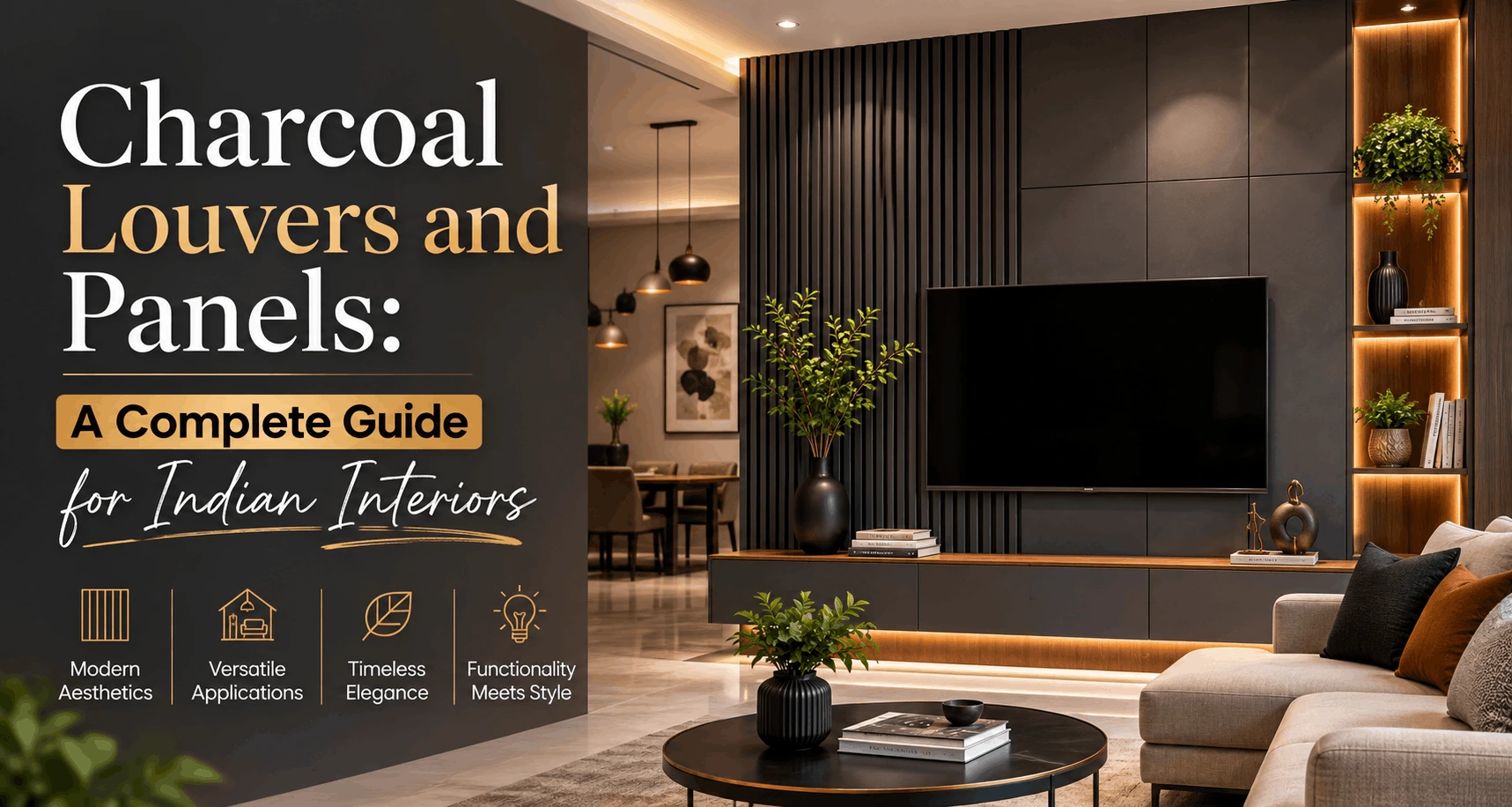
- TV unit and feature wall: the most popular use by far. Charcoal louvers for TV wall backdrops hide cable clutter and add a clean grid behind the screen. Run an LED strip inside the grooves and the slats catch the light for a soft glow.
- Living room accent wall: a single charcoal louvers wall behind the sofa anchors the room and pairs well with light wood and metallic accents.
- Bedroom headboard: a panelled section behind the bed acts as a built-in headboard and removes the need for a bulky padded one.
- Office reception and cabin partitions: charcoal panels make a reception wall look considered, and slatted partitions divide cabins while still letting light pass.
- Ceiling cladding: the same boards run across a ceiling to break up a plain slab and add a finished edge.
- Exterior facade: possible, but only with a material clearly weather-rated. Standard interior PVC charcoal louvers will not hold up outdoors, so check the rating first.
Charcoal Louvers vs Other Wall Finishes
Buyers usually weigh charcoal louvers against the finishes they already know. This table lays out the trade-offs so you can match the finish to the room.
| Finish | Look | Durability | Maintenance | Moisture Tolerance | Rough Cost Band |
|---|---|---|---|---|---|
| Charcoal louvers and panels | Textured, modern, linear | High for indoor use | Low, wipe clean | Moisture-resistant, not waterproof | Mid |
| Wallpaper | Flat, pattern-led | Low to medium | Medium, can peel | Poor in damp areas | Low |
| Paint | Flat, plain | Medium | Medium, needs repaint | Poor without treatment | Low |
| Natural wood veneer | Warm, natural grain | High with care | High, needs polish | Poor unless sealed | High |
| Tiles | Hard, glossy or matte | Very high | Low | Excellent | Mid to high |
The short read is that charcoal louvers sit in a useful middle. They give more depth than paint or wallpaper, ask for far less upkeep than natural veneer, and cost less than a full tiled feature wall, as long as the space is dry.
What Affects Charcoal Wall Panel Price in India?
Charcoal wall panel price is the question almost every buyer reaches first, and the honest answer is that it varies. A few clear factors move the number:
- Material grade: PVC charcoal louvers cost less than denser WPC charcoal panels, and the cheapest board is rarely the best value.
- Finish type: plain matte costs less than premium wood-grain, stone-look, or metallic finishes.
- Panel size and thickness: thicker, larger boards cost more per piece but can mean fewer joints on a big wall.
- Installation complexity: a flat rectangular wall is quick, while walls with cut-outs, niches, or curves take more labour.
As a broad guide, charcoal louvers in India commonly start at a few hundred rupees per square foot at the basic PVC end and run noticeably higher for premium WPC charcoal panels with specialty finishes, before installation. Treat any single figure as a starting point and ask for a project-specific quote, since pricing shifts by brand, city, and order size.
How to Choose the Right Charcoal Louver for Your Project
Use this short checklist before you place an order:
- Room moisture level: dry living and bedroom zones suit most boards, while wet areas need a material rated for it.
- Budget: set a per-square-foot ceiling that includes installation, not just the boards.
- Finish to match your decor: hold a sample against your furniture and flooring in daylight, since charcoal reads differently under warm and cool light.
- Residential or commercial use: a high-traffic office or shop needs a tougher grade than a quiet bedroom wall.
- Verified manufacturer specs: ask for the spec sheet covering material, thickness, finish, and recommended usage areas. A reliable supplier such as Piccaso Ply shares these openly rather than leaving you to guess.
How to Install and Maintain Charcoal Louvers
Installation is straightforward when the base is right. The wall should be even, dry, and clean. Carpenters fix charcoal louvers using adhesive, a screw-and-clip system, or both, depending on the board and the surface. Good interlocking systems hide screws and joints, so the finished wall reads as one continuous surface. On uneven walls, a thin backing board is added first to give a flat fixing base.
Maintenance is light. A dry or lightly damp microfibre cloth handles regular dust. Avoid harsh scrubbers, strong solvents, and standing water, since these can dull the finish over time. That low upkeep is a large part of why charcoal louvers and panels have moved from a niche choice to a mainstream one in Indian interiors.
Frequently Asked Questions
Are charcoal louvers waterproof?
Most charcoal louvers and panels made for interiors are moisture-resistant rather than fully waterproof. They handle humidity and the occasional wipe-down well, which suits living rooms, bedrooms, and offices. For wet zones such as bathrooms, use a board clearly rated as waterproof and confirm it on the product spec sheet.
What is the difference between charcoal louvers and fluted panels?
Charcoal louvers are slat boards with grooves in a charcoal finish. Fluted panels are essentially the same idea with finer, narrower grooves and often a softer texture. Louvers tend to look bolder and more architectural, while fluted panels read as subtle and refined. Both belong to the same charcoal louver design family.
Can charcoal louvers be used on ceilings?
Yes. The same charcoal louvers and panels used on walls run across ceilings to break up a plain surface and add a finished edge. Ceiling installation needs secure fixing and an even base, so a carpenter usually adds a backing board first. It works well in living rooms, reception areas, and bedrooms.
How long do charcoal louvers last?
With normal indoor use and basic cleaning, quality charcoal louvers and panels last many years without fading or warping. Lifespan depends mainly on material grade and where they are installed. Premium WPC charcoal panels in dry, low-traffic rooms outlast cheaper PVC charcoal louvers used in busy or damp spaces.
Are charcoal panels suitable for bathrooms?
Standard charcoal panels are moisture-resistant, not built for constant water, so a regular bathroom is risky for them. If you want the look in a bathroom, use only a board specifically rated as waterproof and keep it away from direct splash zones. Always check the manufacturer usage guidance before fixing.
What is the cost of charcoal louvers per square foot in India?
Charcoal wall panel price varies by material, finish, and installation. Basic PVC charcoal louvers start at a few hundred rupees per square foot, while premium WPC charcoal panels with specialty finishes cost more, before labour. The best approach is a project-specific quote, since rates shift by brand, city, and order quantity.
Charcoal louvers and panels solve a real problem. They add depth and a clean, modern texture to a wall without the cost and upkeep of solid wood. Match the material to the room, check the spec sheet, and hold a sample in daylight, and you will end up with a feature wall that still looks right years later. If you are comparing options, brands like Piccaso Ply offer charcoal panels and louvers across a range of finishes, so you can match the board to the room rather than settle for whatever is on the shelf.